 Skip to content

Marketing terminology can be confusing, even for experienced SMEs

What Hampshire SMEs Really Think About Marketing Jargon and AI
Today, SMEs are navigating an ever-changing marketing landscape. New platforms, shifting terminology and the rise of AI tools are reshaping how businesses create content and make marketing decisions. For many small businesses, this brings both opportunity and uncertainty.
To understand how SMEs are responding, Creative Clique surveyed Hampshire-based business owners and decision-makers about their confidence in marketing, familiarity with industry language, use of AI tools and the role of human expertise.
The findings reveal a clear pattern. AI is commonly used for content creation and idea generation, but human insight and collaboration remain central to trust and strategic decision-making. At the same time, confusion around marketing terminology continues to create friction and, in some cases, prevents SMEs from seeking the marketing support they need.
As an SME ourselves, Creative Clique is navigating the same shifts. This report brings together the voices of fellow business owners to highlight the challenges and opportunities shaping SME marketing today. It offers a grounded view of what businesses really need in an era of fast-changing technology.
Like many SMEs, we used AI tools to produce this report. Not to replace our work, but to support parts of the analysis and help us organise themes. Every insight, recommendation and final interpretation was shaped by our team.
Marketing terminology can be confusing, even for experienced SMEs
Marketing is full of technical terminology, and even experienced business owners sometimes find it tricky to keep track. For example, while most respondents understood individual terms like ‘branding’ (88%) and ‘SEO’ (71%), only 32% of the SMEs surveyed clearly understood all six key marketing terms shared (Brand, SEO, PR, Paid Social, Lead Gen,Content Marketing).
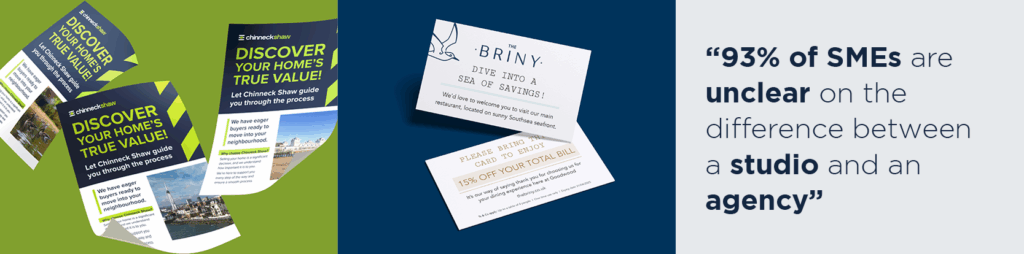
This challenge became particularly noticeable when respondents were asked to explain the difference between a studio and an agency. Only 7% of respondents said they were fully clear on the distinction, meaning 93% expressed some level of uncertainty. It would be unfair to see this as a sweeping reflection of marketing understanding across SMEs, rather, it illustrates the reality of navigating today’s marketing landscape – one where terminology evolves fast with a lack of continuity.
Clear, straightforward communication helps SMEs match services to their needs and reduces friction when seeking marketing support. Simplifying jargon and explaining service offerings in practical terms ensures that SMEs can make informed choices without feeling overwhelmed.
“SMEs are trying to make the right decisions, but marketing terminology doesn’t always make it easy. When the language becomes confusing, businessesnaturally look for simpler alternatives, including AI tools. We believe clarity builds confidence, and that’s what we’re committed to providing.”
– Jo Alexander CEO
SMEs are embracing AI, but carefully
AI adoption among SMEs is high, but it’s largely focused on aiding creative tasks as opposed to replacing human decisions. 76% of respondents said they use AI tools in their marketing, with the most common purpose being to write social posts or blogs (63%), generate ideas or headlines (49%) and create graphics or visuals (39%). It’s mainly used for creative support, as opposed to automation, indicating that SMEs may still be exploring AI at a comfortable, early-adoption stage.
This pattern suggests that AI is being used as a tool for inspiration and efficiency, not as a substitute for human expertise. SMEs clearly recognise its value for generating ideas and streamlining daily tasks, but they continue to rely on their marketing agency partners for strategy, brand positioning and audience understanding. Even when AI is part of the workflow, human oversight remains central to ensuring marketing output is accurate, relevant and aligned with business goals.
Human expertise is still the priority
Even as SMEs adopt AI tools more and more, human expertise remains key in marketing decisions. Our survey shows that 44% of SMEs trust a human agency or studio, while only 5% trust AI tools alone. This demonstrates that – despite AI’s increasing presence – businesses value the experience, insight and collaboration that only a human team can bring.
SMEs highlighted the importance of a personalised service, strategic thinking, and a deep understanding of their brand and audience. AI may assist with content creation or idea generation, but it cannot replicate the empathy or bespoke problem-solving that comes from working with an experienced marketing team.
“AI can assist with visuals, but clients value the creative thinking and design intuition that only a human can provide. Our role is to translate ideas into something meaningful and unique for each business.”
– Glenn Alexander, Lead Designer
Cost and confidence influence decisions
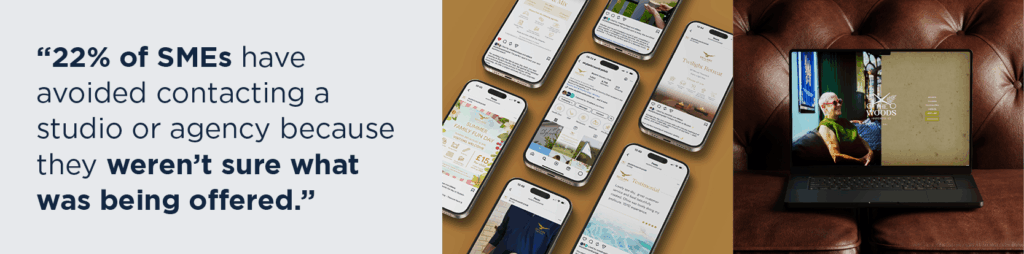
When seeking marketing support, SMEs consider both cost and confidence in their selected agency. While some SMEs know what they want from marketing, others are more cautious due to uncertainty about the services offered or how they align with their goals.
Trust is a key factor in the adoption of AI, and our survey reflects this.
Although 44% of SMEs prefer people-led solutions, 20% indicate their choice could be influenced by cost and 24% remain unsure. Even though SMEs recognise the value of professional marketing support, it seems that uncertainty or cost can cast a sense of doubt.
“Clarity and support go a long way. We work closely with our SME clients to make sure they understand exactly what we can do for them, so they feel fully supported rather than overwhelmed by choices.”
– Florrie, Account Manager
SMEs value collaboration and personalisation in their marketing relationships
Many SMEs emphasised the value of human collaboration in their marketing ,highlighting the importance of personal connection, shared understanding and the ability to refine ideas together.
While AI can support content creation, respondents repeatedly pointed to the importance of marketing partners who understand their brand, listen to their needs and work collaboratively to shape the right approach.
“Collaboration is one of the biggest things SMEs tell us they value. AI can help spark ideas, but it’s the conversations, shared thinking and relationship-building that help turn those ideas into something impactful and on-brand.”
– Lauren Hayward, Social Media Manager
Conclusion
These findings show a marketing landscape that is shifting quickly, but not always clearly. SMEs are embracing AI tools at pace, but it’s largely for creative support– not automation. They value efficiency and inspiration, but still rely heavily on human expertise for strategy, brand interpretation and meaningful collaboration.
At the same time, the continued confusion around terminology and service offerings highlights a need for clearer communication across the industry.
What’s clear is that SMEs want marketing that feels understandable, approachable and aligned to their business goals. They want partners who can simplify the complex, bring creative thinking to the table and work with them – not just for them.
As AI continues to evolve, perhaps the greatest opportunity lies in blending the best of both worlds: human insight supported by intelligent tools.
Creative Clique understands this firsthand. As an SME ourselves, we are navigating the same shifts in technology and client expectations. We feel the same pressure to adapt, explore and learn. This shared experience underpins our human-first approach – one that prioritises clarity, collaboration and creativity above jargon or complexity.
Our hope is that these findings help other SMEs feel more informed and confident as they make their own marketing decisions.
Because while the tools may be changing, the fundamentals remain the same: businesses grow when people connect, communicate clearly and work together towards a common goal.